Every year on Masi Magam (மாசி மகம்), the day of the star Magam in the Tamil month of Masi, Annamalaiyar, the Lord of the great temple at Tiruvannamalai, is taken in procession to the village of Pallikondapattu for theerthavari. There the Lord performs the last rites of Veera Vallalan III, the Hoysala king also known as Veera Ballala III, whom the temple remembers as Vallala Maharaja (வல்லாள மகாராஜா). The festival is called the Masi Magam Theerthavari Utsavam. It is the Lord’s own honour to a king who served him all his life.
Vallalan came to the Hoysala throne in 1292 and ruled for half a century.
His home country was in what is now Karnataka, and his capital was Dwarasamudra, today’s Halebidu, famous for its carved temples. In 1310 he led his army south into the Tamil country to help Sundara Pandyan, who was fighting his half-brother, Veera Pandyan, for Madurai. While he was away, early in 1311, Malik Kafur attacked Dwarasamudra with Sultan Alauddin Khalji’s army, on the same campaign that went on to raid Srirangam. Vallalan rushed home and sent envoys to make peace. The reply came back that the general had come to change the king’s faith. Vallalan gave up his treasure instead, and kept the one thing he would not give up. S. Krishnaswami Aiyangar, in his book South India and her Muhammadan Invaders (1921), puts it in one line:
The Rai agreed to surrender all his property ‘except his sacred thread’.
Aiyangar

He rebuilt Dwarasamudra and kept his kingdom standing while the kingdoms around it fell. When Dwarasamudra was plundered a second time, in 1327, he moved south and made Tiruvannamalai his capital, calling it Arunasamudra, the ocean of Aruna. From here, at the foot of the hill that is worshipped as Shiva himself, he ruled his kingdom and planned his wars.
He was also one of the temple’s greatest patrons. The inscriptions on its walls record his gifts for lamps, food offerings and processions, for the people who served the Lord, and for alms houses. They were among the largest gifts the temple had ever received from one person.
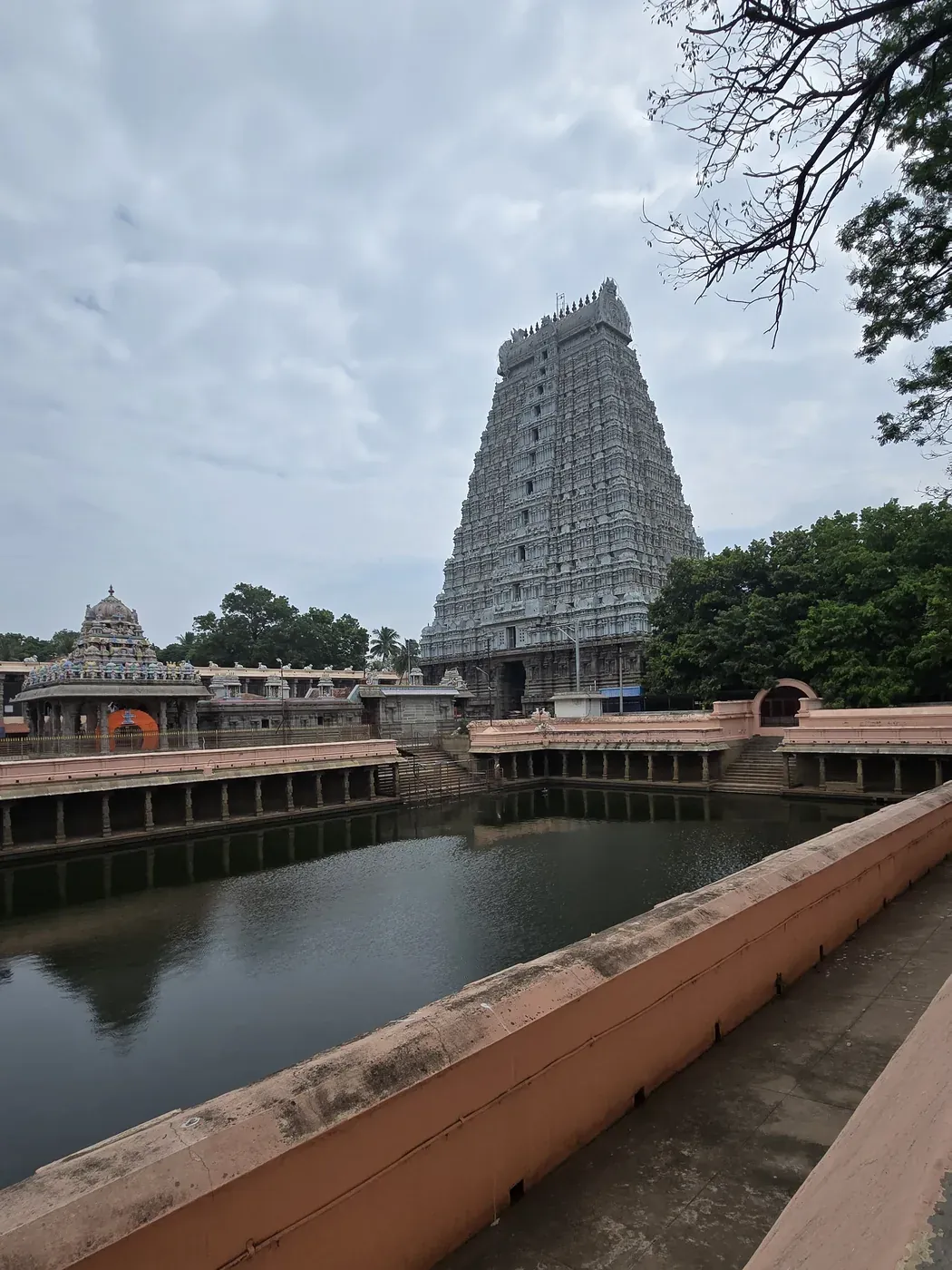
Walk into the temple from the east today and you first pass under the Rajagopuram, two hundred and seventeen feet high, with eleven tiers. It was begun under Krishnadevaraya of Vijayanagara, nearly two hundred years after Vallalan’s time. Just beyond it stands an older, darker tower, the gateway to the fourth prakaram. It carries his name: the Vallala Maharaja Gopuram. His service to the temple earned him that place.

The king is inside the temple too. In a niche in the wall of his own gopuram stands a stone figure of him, old and bearded, with his palms joined towards the Lord. Someone still dresses him: a turban of cloth and pearls sits on his stone head, and offerings are tied below his feet.

There is a story the temple tells about the king and the Lord.
Vallalan was known for his honesty, his generosity, his kindness and his love for the Lord. It is said that the Lord once came to the king and his queen as a little child. The king took the child lovingly into his arms, and then the child vanished. Because the king had held him so, the Lord promised that when the time came, he himself would perform the king’s funeral rites.
Old as he was, Vallalan kept fighting for the south.
In about 1341 the Sultan of Madurai, Ala-ud-din Udauji, fought the Hoysala army. The Sultan’s men were winning, but as he took off his helmet to drink, an arrow from an unknown hand killed him on the spot. What had almost been a defeat for Vallalan became a victory.
In 1342 Vallalan was eighty years old, and he went to war one more time.

The new Sultan of Madurai, Ghiyas-ud-din Muhammad Damghani, held the fortress at Kannanur Koppam, next to today’s Samayapuram, a few miles north of Srirangam. Kannanur had once been a Hoysala capital itself. Vallalan marched on it with an army of a hundred thousand men. In the first battle he crushed the Sultan’s forces and drove what was left of them back to Madurai. Then he laid siege to the fort.
The siege lasted ten months. By the end the garrison had only fourteen days of food left, and Vallalan made them an offer: give up the town, and they could march back to Madurai safely. They asked for time to write to their Sultan for permission, and he gave them a truce of fourteen days.

The answer from Madurai was an army. Vallalan fought by the rules of dharma yuddha, under which no one fought after sunset, so at night the Hoysala camp rested. Late in the night, a chosen band of the Sultan’s horsemen, men ready to die, rode into the sleeping camp. No one expected them. As the camp woke in confusion, the rest of the Sultan’s army attacked, and the Hoysala ranks were cut to pieces. In the chaos the old king was captured.
Then came the second betrayal. Ghiyas-ud-din promised the king that if he surrendered and handed over his wealth, no one else would be harmed. To save his people, Vallalan agreed. A treaty was signed, and he gave up his treasure, his elephants, his horses and everything else he owned. As soon as it was signed, the Sultan had him killed and skinned. The Moroccan traveller Ibn Battuta, who came to the Sultan’s court at Madurai soon afterwards, wrote that
his skin was stuffed with straw and hung up on the wall of Moutrah (Madura) where I saw it suspended.
Ibn Battuta
This was in 1343. The temple remembers that he died in the month of Masi, on the day of the star Magam.
He was the last great king of the Hoysalas. By holding out in the south for so long, he kept the ground for the new power rising at Vijayanagara under Harihara, which took over his kingdom within a few years. Around 1370 Kumara Kampana of Vijayanagara captured Madurai and ended the Sultanate there. His wife Gangadevi told the story of that campaign in her Sanskrit poem Madhura Vijayam.

And so, every Masi Magam, the Lord goes out to Pallikondapattu.
Pallikondapattu is a village about three kilometres from the temple. It is said that King Vallalan had a palace there. In the month of Masi the temple priests read out the news of the king’s death to Annamalaiyar. Then, on Masi Magam, the Lord is carried in procession to the bank of the small stream at the western end of the village for the theerthavari, and the king’s last rites are performed there, as the Lord promised.
In 2018, members of the Tiruvannamalai District History Research Centre found a stone carved with Vallalan's emblem lying about a hundred feet from the theerthavari mandapam.
He was betrayed twice in his last days and killed far from his temple, yet the Lord he served still honours him there. Very few kings anywhere are remembered like this.
In 1342 Namperumal was still in exile, nineteen years from home, and Kannanur is only a few miles from Srirangam. If the men who had carried him away heard that an old king was marching on Kannanur, what did they dare to hope?
a novel